Luck Pillars Calculator — See Your 10-Year Luck Cycle
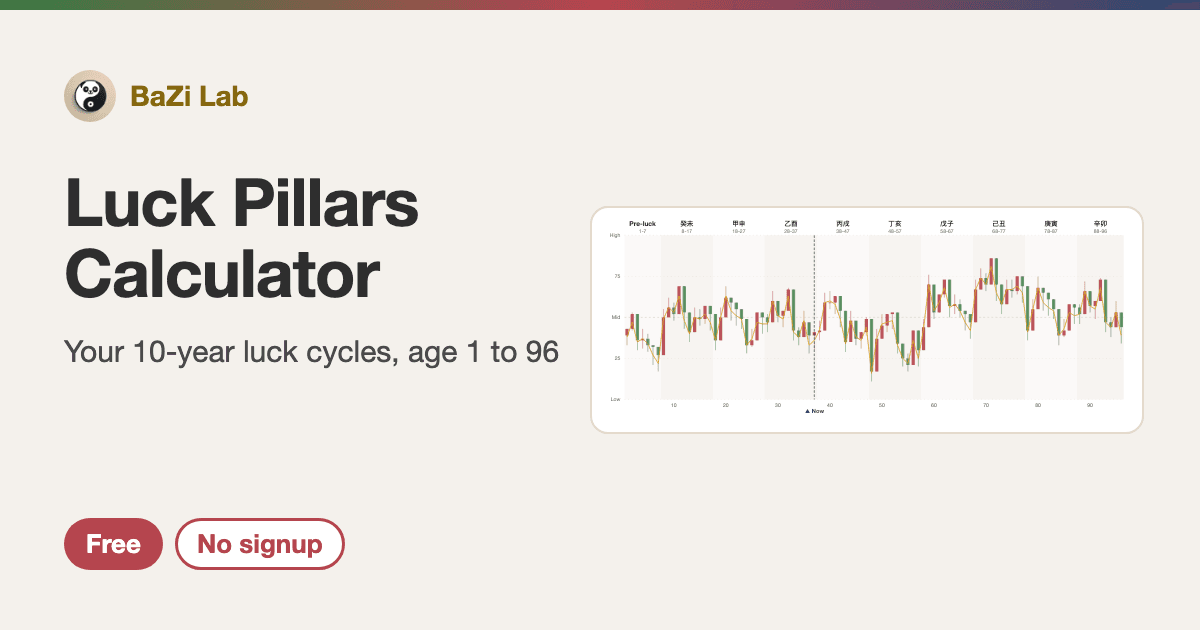
In BaZi (Four Pillars of Destiny), your life is divided into ten-year stretches called luck pillars (大运, da yun). Each one shifts the background conditions of your life for a decade. This page calculates your luck pillars from your birth details and plots them as a single curve, so you can see the shape of the whole cycle at once.
Life Trajectory
Luck pillar & annual energy curveDay Master 辛(Metal) · Weak · Favorable Earth, Metal · Unfavorable Wood, Fire, Water · Luck starts at age 8
Scroll horizontally to see the full lifespan
Peak years
- 2060 庚辰 · age 71
- 2058 戊寅 · age 69
- 2048 戊辰 · age 59
Low years
- 2037 丁巳 · age 48
- 2044 甲子 · age 55
- 1996 丙子 · age 7
Derived from BaZi rules — the same chart always yields the same curve. For reflection only, not advice.
Want the full chart and a reading for each pillar?
Generate my full BaZi chart — freeWhat is a luck pillar?
A luck pillar is a ten-year period described by one Heavenly Stem and one Earthly Branch — the same notation used for the four pillars of your birth chart. Where your birth chart says what you are made of, the luck pillar says what conditions you are operating under.
The sequence is not random and not chosen. It runs forward or backward from your month pillar, and which direction it runs depends on your gender combined with the yin-yang polarity of your year stem. A man born in a yang year moves forward through the sixty-year cycle; a woman born in the same year moves backward. This is why two people born minutes apart can have opposite luck sequences.
Your first pillar does not begin at birth. It starts at your starting age (起运), calculated from how many days separate your birth from the nearest solar term. Before that, the years are governed by your month pillar.
How to read the luck pillar chart
The shaded bands across the top of the chart are the ten-year pillars, labelled with their stem-branch pair and the ages they cover. The height of the curve inside each band is what that decade does for you: pillars that supply what your Day Master lacks sit high, pillars that drain it sit low.
Inside each band, one candle is one year — the annual pillar (流年). The body of the candle shows where the year ended relative to where it began, and the wick shows the range across the twelve months. A strong year inside a weak decade still reads as a good year, just against a lower baseline.
The gold line is the annual average, and the dashed marker shows where you are now. Most people find the shape more useful than any single number: whether your chart climbs late, peaks early, or runs flat tells you more about pacing than a score does.
When does your luck pillar change?
Every ten years, counting from your starting age. If you start at 8, your pillars change at 18, 28, 38 and so on. The transition is not a switch thrown on your birthday — the influence of a new pillar tends to be felt over the year or two around the change, and the last two years of an old pillar often already carry the flavour of the next.
Pillar changes are worth planning around precisely because they are predictable. Unlike an annual pillar, which comes and goes, a luck pillar sets the terms for a decade.
Luck pillars vs. annual pillars
The annual pillar changes every year and produces the visible ups and downs. The luck pillar changes every ten years and sets the level those ups and downs happen around. Reading one without the other is the most common mistake: a difficult year inside a supportive decade is an inconvenience, while the same year inside a draining decade is the one people remember.
On the chart above, this is literally the difference between the height of a band and the height of a candle inside it.
How this chart is calculated
The stem-branch sequence is computed from the calendar, not generated by a language model. Direction, starting age, each of the ten pillars and every annual and monthly pillar are derived arithmetically — the same chart always produces the same result.
The scoring layer determines whether your Day Master is strong or weak, derives which of the Five Elements support it, and rates each pillar, year and month against that. It is a rule-based reading of a classical method, offered for reflection rather than as advice.
Common questions
- What is a luck pillar in BaZi?
- A luck pillar (大运) is a ten-year period in your BaZi chart, described by one Heavenly Stem and one Earthly Branch. It sets the background conditions of your life for that decade, while your birth chart describes your fixed nature.
- How do I calculate my 10-year luck cycle?
- Your luck cycle runs forward or backward from your month pillar depending on your gender and the yin-yang polarity of your year stem, starting at an age derived from the distance between your birth and the nearest solar term. Enter your birth date, hour and gender above and the chart is generated instantly.
- How do you interpret luck pillars?
- Compare each pillar against what your Day Master needs. Pillars carrying the elements that support a weak Day Master, or that drain a strong one, read as favourable. The chart above shows this as height: supportive decades sit above the midline, draining ones below.
- When does my luck pillar change?
- Every ten years from your starting age. If your starting age is 8, the changes fall at 18, 28, 38 and so on. The influence typically shifts over the year or two surrounding the change rather than overnight.
- Is the luck pillars calculator free?
- Yes. The chart, the ten-year pillars and the year-by-year curve are free and require no account. Written analysis of each pillar is part of the paid Luck Pillars report.
- Do I need my exact birth time?
- For the luck pillars themselves an approximate hour is usually enough, since the sequence depends mainly on your birth date. An exact time matters more for the hour pillar of your birth chart — use the full BaZi calculator for that.