BaZi Compatibility Calculator: Compare Two Birth Charts
Discover how compatible you are with your partner based on ancient Chinese BaZi astrology. Enter birth details for both people to reveal your relationship dynamics.
Just want your own chart first? Free BaZi calculator →
You
Enter your birth details
Your Lover
Enter their birth details
All information is used only for analysis and not stored on our servers.
What is BaZi Love Compatibility?
Ancient Wisdom for Modern Love
BaZi love compatibility analysis examines the interaction between two people's birth charts based on ancient Chinese astrology principles. It reveals natural tendencies, potential challenges, and harmonious aspects of your relationship.
Beyond Western Astrology
Unlike western astrology that focuses primarily on sun signs, BaZi examines the complete energy pattern from your birth time, including the Five Elements (Wood, Fire, Earth, Metal, Water) and their interactions.
Comprehensive Insights
Our analysis provides insights into:
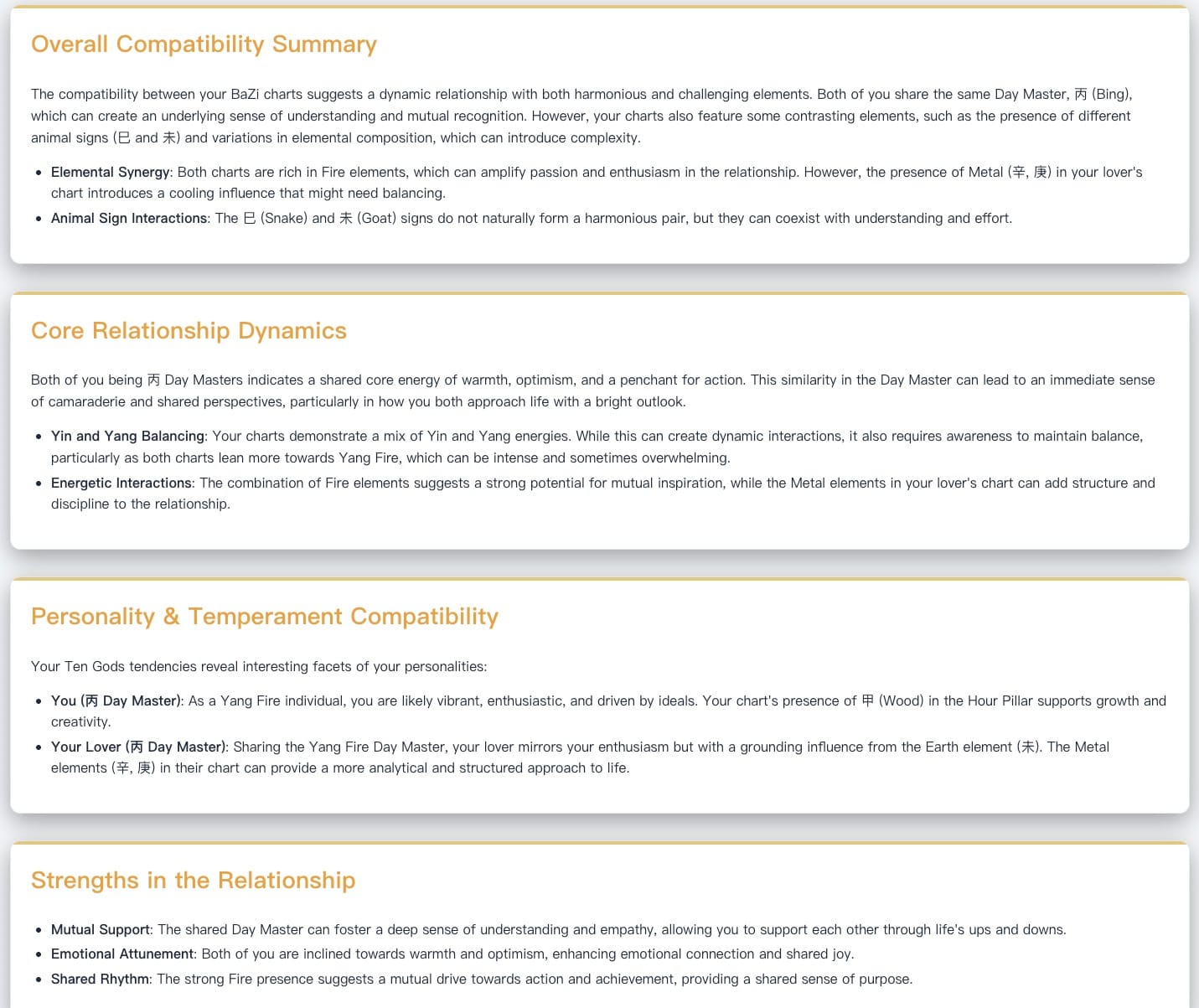
Understanding your BaZi compatibility gives you a deeper insight into the energy dynamics that shape your relationship journey.
How this BaZi compatibility score is calculated
Two steps — and it is not the same thing as star-sign matching. First each person's birth details are turned into a full chart: the clock time is corrected to true solar time for the birthplace (including China's 1986–1991 daylight saving), then the year, month, day and hour pillars are cast. Only then are the two charts compared.
The comparison weighs four things, in descending order: how the two Day Masters relate (who feeds whom, who drains whom), whether the two element profiles complement each other, how the day and month branches combine or clash, and which Ten God each shared element plays in each chart.
- Enter both people's birth details — Birth date, birth time and birthplace for each person. The birthplace sets the time zone and longitude, which directly affect the hour pillar.
- Cast each chart — The clock time is corrected to true solar time using the legal offset at that birthplace, then the year, month, day and hour pillars are cast.
- Compare four relationships — Day Master interaction, element complement, branch combinations and clashes, and Ten God placement are combined into one weighted score.
- Read the result — The score is read in five bands (80+, 65–79, 50–64, 35–49, below 35), together with which pillar the friction sits in.
- Only birth date, birth time and birthplace are needed — no questionnaire;
- Time zones use the legal offset in force at the birthplace on that date, so two cities in China do not collapse into the same hour pillar;
- The score is a weighted result of those four comparisons, not a random number: the same pair always produces the same score.
What each score range means
The score describes how well two charts work together. It does not decide whether a relationship should continue, and two couples in the same band can behave very differently.
| Score | Band | How to read it |
|---|---|---|
| 80+ | Strongly complementary | Feeding Day Masters, complementary elements, low friction |
| 65–79 | Broadly smooth | One or two recurring negotiation points |
| 50–64 | Both complement and friction | The analysis points to the pillar involved |
| 35–49 | More draining | Needs deliberate topping up from both sides |
| <35 | Mostly against each other | Where it clashes matters more than the number |
- 80 and above: Day Masters that feed each other and complementary elements — low day-to-day friction, but a tendency to coast;
- 65–79: broadly smooth, with one or two recurring negotiation points (usually money or pace);
- 50–64: real complement and real friction, and the analysis points to which pillar the friction sits in;
- 35–49: more draining than nourishing — it needs deliberate topping up, which is not the same as "incompatible";
- Below 35: most of the four comparisons run against each other. Knowing where they clash matters more than the number.
Two charts side by side (a real example)
Below are two charts produced by the same engine that runs this calculator — not hand-written sample numbers. Both use Beijing as birthplace, so the true-solar-time correction here includes both the longitude gap and China's 1990 daylight saving.
Person A
1990-06-15 10:30 · Beijing
Year
庚午
Month
壬午
Day
辛亥
Hour
癸巳
Day Master:辛(金) · weak(23%)
Favourable:土, 金
True solar time -74 min
Person B
1992-11-02 08:15 · Beijing
Year
壬申
Month
庚戌
Day
壬午
Hour
甲辰
Day Master:壬(水) · weak(37%)
Favourable:金, 水
True solar time -14 min
- A's Day Master element feeds B's
- A's Day Master element (金) is among the elements B's chart favours; B's Day Master element (水) is not among those A's chart favours.
Beyond romance: partners, family, work
The same comparison logic applies to business partners, parents and children, and colleagues — with different weights. For a business partnership the wealth and authority stars matter more than the day-branch chemistry; for a parent and child it is the parent and child stars, not the romance palace.
Roughly a third of the people searching "bazi compatibility" are not asking about romance. You do not need to pick a relationship type up front: the result page gives short readings for partnership, family and romance at once.
Frequently Asked Questions
Common questions about BaZi love compatibility analysis
How accurate is BaZi compatibility analysis?
BaZi compatibility analysis is based on ancient Chinese astrological principles that have been refined over thousands of years. While it provides valuable insights into relationship dynamics based on birth energy patterns, it's best used as one tool among many for understanding relationships. The accuracy depends on having precise birth information, including the exact time and location of birth for both individuals.
Do I need to know my exact birth time?
Yes, for the most accurate BaZi analysis, knowing the exact birth time is crucial. The birth hour affects your time pillar, which is one of the four pillars in your BaZi chart. If you don't know the exact time, you can use an estimate, but the analysis may not be as precise, particularly regarding certain aspects of your personality and relationship dynamics.
What is the difference between BaZi and Western astrology compatibility?
BaZi (Chinese astrology) and Western astrology differ in several key ways. BaZi focuses on the balance of the Five Elements (Wood, Fire, Earth, Metal, Water) in your birth chart and how they interact with the elements in your partner's chart. It analyzes the relationship between your Day Master (representing your core self) and your partner's chart. Western astrology, on the other hand, primarily looks at planetary positions and how they form angles (aspects) with each other.
Can BaZi compatibility predict if a relationship will last?
BaZi compatibility analysis cannot definitively predict whether a relationship will last, as lasting relationships depend on many factors including personal growth, effort, and choices. What BaZi can do is highlight natural strengths and potential challenges in your relationship, helping you understand areas where you may need to put in extra effort or awareness.
What does the compatibility score actually mean?
The compatibility score represents an overall assessment of how well your energies naturally complement each other based on BaZi principles. A higher score indicates more natural harmony and ease in the relationship, while a lower score suggests more areas where conscious effort might be needed. Remember that even relationships with lower scores can be successful with awareness and effort!
How can I improve compatibility if our score is low?
If your compatibility score is lower than expected, focus on the specific challenges highlighted in your analysis. Understanding these potential friction points can help you develop strategies to address them consciously. Communication is key—discuss the insights with your partner and work together on areas that might need attention.
Is there a free BaZi compatibility test?
Yes. The calculator on this page is free and does not require an account: enter both birth dates, times and birthplaces and you get the score with the four comparisons behind it. A longer written reading for the pair is a paid report, but the score and its breakdown are not gated.
Can I use it for marriage and long-term partners?
Yes, and it is the same calculation. Marriage questions usually care most about the day branch and the spouse palace, so read the day-pillar comparison first, then the element balance. A short relationship and a long marriage use the same chart pair — what changes is how much weight you give the friction points.
Does it work if we were born in different countries?
Yes, and this is where most free calculators go wrong. The birth time has to be corrected to true solar time using the legal UTC offset in force at that birthplace on that date, plus the longitude. Two people born at 10:30 — one in Beijing, one in Chengdu — are not born in the same hour pillar, and two people born in different countries need different offsets, including historical daylight saving.
What is the difference between compatibility and a full reading?
Compatibility compares two charts and stops at the relationship: which elements help, which clash, and where the friction sits. A full reading goes through one chart on its own — Day Master strength, Ten Gods, luck pillars and the current year. If you want to understand yourself first, start with a single chart reading; if the question is about the two of you, use the compatibility calculator.
Related reading
- Zodiac CompatibilityAll 12 signs against each other — harmony, clash, harm and punishment
- Free BaZi CalculatorGenerate your full Four Pillars chart in seconds
- The Ten GodsWhat each stem relationship says about you
- Five Elements CalculatorCount the Wu Xing in your chart and find your useful element
- BaZi ReportsIn-depth readings for career, wealth and relationships