BaZi Chart: A Complete Worked Example
A BaZi chart maps your birth year, month, day, and hour into four "pillars" — two characters each, eight in total. This page takes one real chart, computed by the same engine as our free BaZi calculator, and reads it from top to bottom: what each pillar means, how the day master is judged, what the ten gods and hidden stems say, and how the ten-year luck pillars unfold.
The chart used in this example
Everything on this page comes from one birth record. Put the same data into the calculator and you get the identical chart — the engine is deterministic, and its calculation version is stamped on every result.
15 June 1990, 10:30 clock time — Beijing, 116.4°E, male
One detail worth pausing on: the clock said 10:30, but the chart was cast for 09:16. The engine applied a true solar time correction of 74 minutes before assigning pillars: in the summer of 1990 China still ran daylight saving time (legal clocks at UTC+9), and Beijing’s longitude (116.4°E) puts local mean solar time another 14 minutes ahead of the UTC+8 basis. Corrections like this decide the hour pillar for anyone born near an hour boundary — that is why the calculator asks where you were born, not just when.
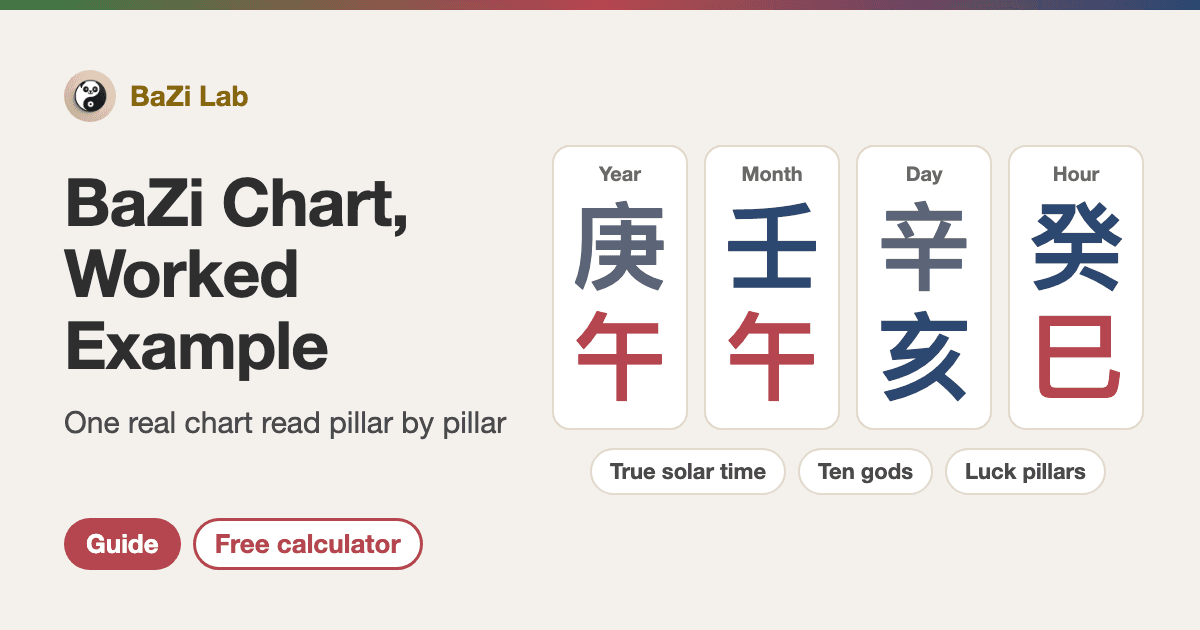
The chart reads 庚午 · 壬午 · 辛亥 · 癸巳. Every number on this page — the strength percentage, the luck-pillar ages, the current step — is produced by the same engine the calculator runs, not typed in by hand.
The mechanism behind clock-to-sun corrections is explained in the true solar time guide.
What each pillar means
The month pillar carries extra weight: it sets the season the whole chart lives in. Here the month branch is 午 — mid-summer, peak fire. Every judgment that follows starts from that fact.
| Pillar | Characters | Ten god (stem) | Hidden stems |
|---|---|---|---|
| Year | 庚午 | 劫财 Rob Wealth | ancestors, early environment, the wider world丁 · 己 |
| Month | 壬午 | 伤官 Hurting Officer | parents, siblings, career climate — the season pillar丁 · 己 |
| Day | 辛亥 | 日主 | the self, and the spouse palace in its branch壬 · 甲 |
| Hour | 癸巳 | 食神 Eating God | children, later years, inner ambitions丙 · 庚 · 戊 |
The year pillar 庚午 also fixes the animal sign — the Horse; the Chinese zodiac signs cover that simpler layer.
The day master: 辛 Metal, running at 23% strength
The day stem is 辛 (Metal) — that character is "you" in the chart, and every other character is described by its relationship to it.
A day master is judged against its season. 辛 Metal born in the fire month of mid-summer is under pressure: fire melts metal. The engine weighs the supporting characters (resources and peers) against the draining and controlling ones, and for this chart the supporting share comes out at 23% — well under the 40% line that separates a strong day master from a weak one. The verdict: weak 辛 Metal, which traditionally reads as someone who gains strength from support rather than from pushing alone.
Weakness is not badness; it just points the compass. For a weak day master the favorable elements are the ones that feed or support it — here Earth, Metal — while the remaining elements drain or attack it. This is the same judgment our life-trajectory curve uses to score years, so what you read here matches what the results page shows.
A fuller treatment lives in the day master guide.
Ten gods: how every other character relates to you
Each of the other seven characters gets a role — a "ten god" — based on its element and polarity relative to the day master. The stems sit in the table above: 庚 becomes Rob Wealth, 壬 Hurting Officer, 癸 Eating God.
Branches are not single elements: each hides one to three stems, and those hidden characters carry their own ten gods.
| Branch | Hidden stems | Ten gods on this chart |
|---|---|---|
| 午(Year pillar) | 丁 · 己 | 七杀 Seven Killings · 偏印 Owl God |
| 午(Month pillar) | 丁 · 己 | 七杀 Seven Killings · 偏印 Owl God |
| 亥(Day pillar) | 壬 · 甲 | 伤官 Hurting Officer · 正财 Direct Wealth |
| 巳(Hour pillar) | 丙 · 庚 · 戊 | 正官 Direct Officer · 劫财 Rob Wealth · 正印 Direct Resource |
Reading the layout rather than memorizing it: the output star 伤官 is transparent — it sits on the month stem backed by the day branch — so expression and expertise are loud here. The authority stars (七杀, twice hidden in the season branches) never surface on a stem — pressure that is felt rather than shown.
The full roster and what each star means lives in the ten gods reference.
Five elements: counting what the chart is made of
| Element | Count | Where |
|---|---|---|
| 金 (Metal) | 2 | 庚, 辛 |
| 水 (Water) | 3 | 壬, 癸, 亥 |
| 火 (Fire) | 3 | 午, 午, 巳 |
| 木 (Wood) | 0 | hidden only — not on the surface |
| 土 (Earth) | 0 | hidden only — not on the surface |
Two "zeros" look dramatic, but a main-element count is not a verdict. Wood survives as hidden 甲 inside the day branch, earth as hidden 己 and 戊 in the fire branches — hidden characters still act, just less visibly. What the count does tell you is the chart’s temperature: hot and wet, thin on support — exactly why the day master above came out weak.
To see your own distribution, the five elements calculator counts it for you.
Branch interactions: what pairs of branches do to each other
Beyond individual characters, branches interact in pairs and groups. Five relationships cover most of what you will meet — the table shows which of them this chart actually hits.
| Relationship | Pairs that form it | On this chart |
|---|---|---|
| Six harmony (六合) | 子丑, 寅亥, 卯戌, 辰酉, 巳申, 午未 | — |
| Three harmony (三合) | 申子辰 (Water), 寅午戌 (Fire), 巳酉丑 (Metal), 亥卯未 (Wood) | — (needs all three) |
| Six clash (六冲) | 子午, 丑未, 寅申, 卯酉, 辰戌, 巳亥 | 亥–巳(Day pillar – Hour pillar) |
| Six harm (六害) | 子未, 丑午, 寅巳, 卯辰, 申亥, 酉戌 | — |
| Self-punishment (自刑) | 辰辰, 午午, 酉酉, 亥亥 | 午–午(Year pillar – Month pillar) |
A rarer punishment group (刑, such as 寅巳申) also exists, but the table above settles most charts.
Interactions are checked before luck pillars, because they change how a chart absorbs a new ten-year cycle. They are also why two calculators can disagree: a different day boundary or daylight-saving rule produces a different hour branch — and with it, different interactions. Our engine states its conventions on every result.
Luck pillars: the ten-year timetable
For a male born in a yang-stem year (庚), the luck pillars run forward from the month pillar, and this chart starts at age 8 (a female born in a yin-stem year runs the opposite direction — the table logic is otherwise the same). Ages here are virtual age: 1 at birth, +1 each lunar new year:
| Step | Pillar | Ages |
|---|---|---|
| 1 | 癸未 | 8–17 |
| 2 | 甲申 | 18–27 |
| 3 | 乙酉 | 28–37 |
| 4 | 丙戌 | 38–47 |
| 5 | 丁亥 | 48–57 |
| 6 | 戊子 | 58–67 |
| 7 | 己丑 | 68–77 |
| 8 | 庚寅 | 78–87 |
| 9 | 辛卯 | 88–96 |
As of 2026 this person (age 37) sits in the 乙酉 step (ages 28–37, 2017–2026).
Each step shifts the environment’s element mix for ten years. Notice the metal steps 乙酉 and 庚寅 — they deliver the favorable element identified in the day-master section, which is why a traditional reading would call those stretches supportive.
To generate this table for your own birth data, the luck pillars calculator does it in seconds.
Three mistakes to avoid when reading a chart
- Counting five elements without hidden stems. A "zero" on the surface — like Wood here — does not mean absence; hidden 甲 still acts, just less visibly.
- Reading luck pillars before strength. The timetable only means something once you know which elements help this day master: for a weak 辛 metal, a Fire step and a Metal step are opposite experiences.
- Trusting a chart without checking conventions. Day boundaries, daylight saving, true solar time — two calculators using different settings will disagree near boundaries. Compare settings before deciding either is "wrong" (see the FAQ).
- And one habit worth keeping: a single star or a single zero is never a verdict — the chart is read as a whole, in the order below.
Read your own chart the same way
The order used on this page is the order to reuse: pillars first, then day master and strength, then ten gods (stems and hidden), then element counts, then branch interactions, and only then the luck timetable. The concepts behind each step live in the BaZi reading guide; this page applies them to one chart instead of re-teaching them. One boundary worth stating: a chart describes relationships between characters as a traditional framework — the honest use is reflection, not prediction.
Your chart is one form away
Run your own birth data through the calculator — no signup needed to see the chart — and compare each block against the example above.
Frequently asked questions
Is this a real chart, or an illustration?
A real one. It is generated by the same deterministic engine behind the free calculator (the same one that stamps a calculation version on your results), from a fixed sample birth record: 15 June 1990, 10:30, Beijing, male. Nothing on this page is hand-drawn astrology.
Why does 10:30 a.m. become 09:16?
True solar time. In the summer of 1990, China observed daylight saving time (clocks at UTC+9), and Beijing’s longitude places local mean solar time ahead of the UTC+8 clock. The combined correction is −74 minutes. If the corrected time had crossed an hour boundary, the hour pillar would have changed.
What if I don’t know my exact birth time?
Start with the year, month, and day pillars — none of them needs the hour, and the day master plus most of the ten-god layout is already readable. What you lose is the hour pillar, the interactions that involve it, and precision on the luck-pillar start age. Don’t invent a time (the usual "noon guess") — a wrong hour can flip the hour pillar and everything built on it. If the record matters, recover it from family documents or birth records before calculating.
Can two calculators give different charts for the same birth data?
Yes, when they use different conventions: whether the day rolls at 23:00 or 00:00, whether months follow solar terms, how historical daylight saving is handled, and whether true solar time is applied. A trustworthy calculator shows its settings; compare conventions before deciding either result is "wrong".
What does it mean that Wood and Earth count zero?
Only that they don’t appear as a stem or a branch’s main element on the surface. Both exist hidden inside branches here (wood in 亥, earth in 午 and 巳). Surface counts describe the chart’s visible texture; they feed the strength judgment, they don’t replace it.
How do I get a chart like this for my own birth data?
Use the free BaZi calculator: enter date, time, and birthplace, and the same engine produces your pillars, ten gods, day-master verdict, and luck timetable. Save the chart (free account) if you want monthly reports built on it.