ChatGPT BaZi Reading: A Prompt Template and Four Checks Before You Trust It
Asking ChatGPT for a BaZi reading is quick: paste a birth date and ask what it means. The interpretation can be thoughtful. The problem usually sits one step earlier, in the Four Pillars the answer is built on. A general chat model writes the most likely text; it does not run a Chinese calendar, and BaZi pillars change at solar terms, not at New Year.
This guide gives you a prompt that works, and four checks that take two minutes and catch the mistakes that matter most.
Step 1: Calculate the Chart First, Then Prompt
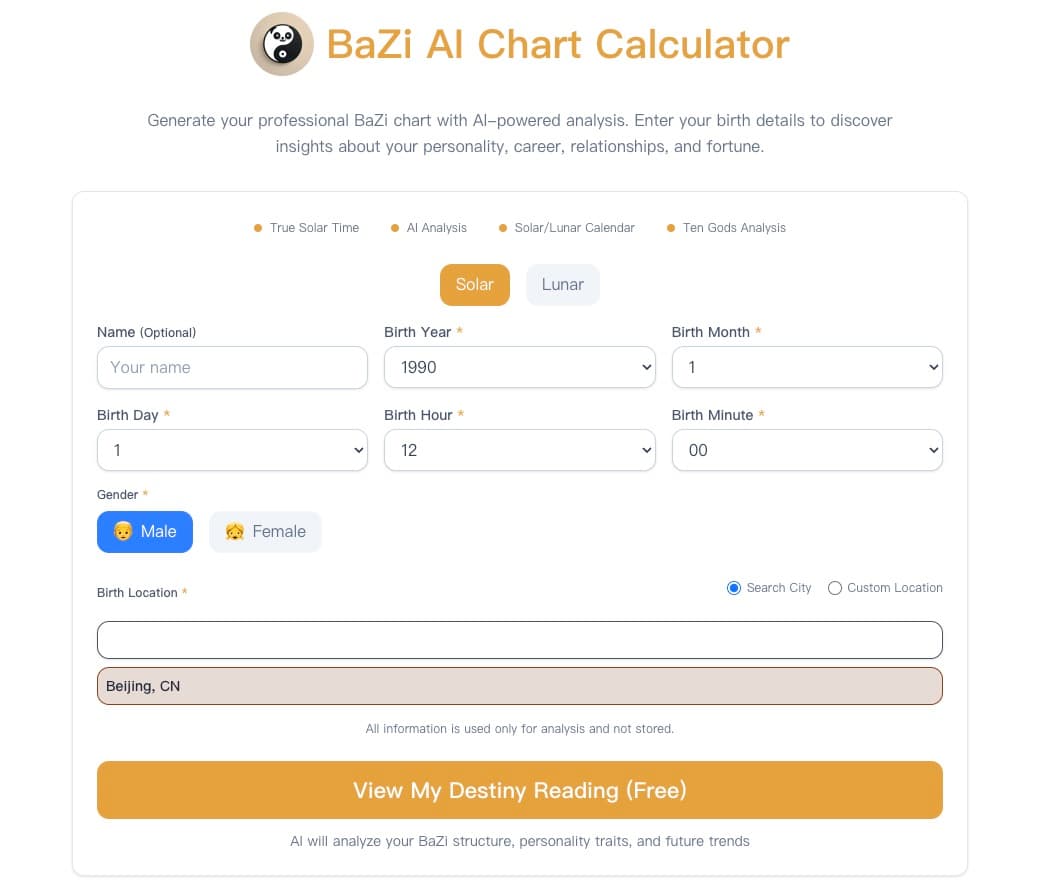
Do not ask a chat model to work out your pillars. Calculate them with a calendar engine — the free BaZi calculator shows all four pillars, the hidden stems and the corrected birth time — and paste the result into your prompt. Then the model only has to interpret, which is the part it is good at.
A Prompt Template You Can Copy
Replace the parts in brackets. Keep the chart lines exactly as your calculator shows them.
The instruction not to recalculate matters. Without it, models sometimes silently replace your pillars with their own.
Four Checks Before You Trust the Pillars
Whichever tool produced your chart — a chat model, an app or a website — these four points are where results most often disagree. Every example below was run through BaZi Lab's calendar engine.
1. The Year Pillar Changes at the Start of Spring, Not Chinese New Year
Take a birth on 1 February 1990 at noon. Chinese New Year fell on 27 January 1990, so the lunar calendar already counts the day as part of a 庚午 (Metal Horse) year. But BaZi years begin at the Start of Spring solar term (立春), which arrived on 4 February 1990 at 10:14 Beijing time. The correct year pillar is therefore 己巳 (Earth Snake), and the full chart is 己巳 丁丑 丁酉 丙午.
If a reading calls this person a Horse, it used the lunar New Year as the boundary. Anyone born between late January and early February should check this first.
2. The Month Pillar Changes at Solar Terms Too
Months in BaZi run from one solar term to the next, not from the first of the month. In 1990 the Grain in Ear term (芒种) began on 6 June at 06:46. A birth on 5 June 1990 has the month pillar 辛巳; a birth on 15 June has 壬午. A chart built on the lunar month, or simply on the calendar month, can be one pillar off for anyone born in roughly the first week of a Western month.
3. Births Between 23:00 and Midnight
The Zi hour (子时) runs from 23:00 to 01:00, and schools disagree about when the day pillar changes inside it. BaZi Lab keeps the day pillar until midnight: 15 December 1990 at 23:30 Beijing time (120°E) is day 甲寅 with hour 丙子, while 00:30 the next morning is day 乙卯 with hour 丙子. True solar time is applied first, so 23:30 on the clock in western China can already fall before 23:00. Other conventions switch the day at 23:00. Neither is a calculation error, but you should know which one your chart uses, and tell the model not to switch.
4. Luck Pillar Direction Depends on Gender and the Year Stem
Ten-year luck pillars (大运) run forward or backward from the month pillar. The direction depends on whether the year stem is yin or yang, and on gender. For 15 June 1990 at 10:30 (year stem 庚, yang):
Same birth moment, completely different decades. If a reading describes your luck pillars without asking your gender, it guessed. The luck pillars guide explains how the direction and start age are worked out.
Where a Prompt Still Falls Short
A Shorter Route
BaZi Agent is built the other way round. It calculates the pillars, true solar time and luck pillars with the calendar engine first, shows them as cards you can check, and only then answers. If birth details are missing, it asks with a short form instead of guessing. You can try it without signing up, five conversations a day.