Chinese Zodiac Elements: How to Find Yours by Birth Year (and What It Leaves Out)
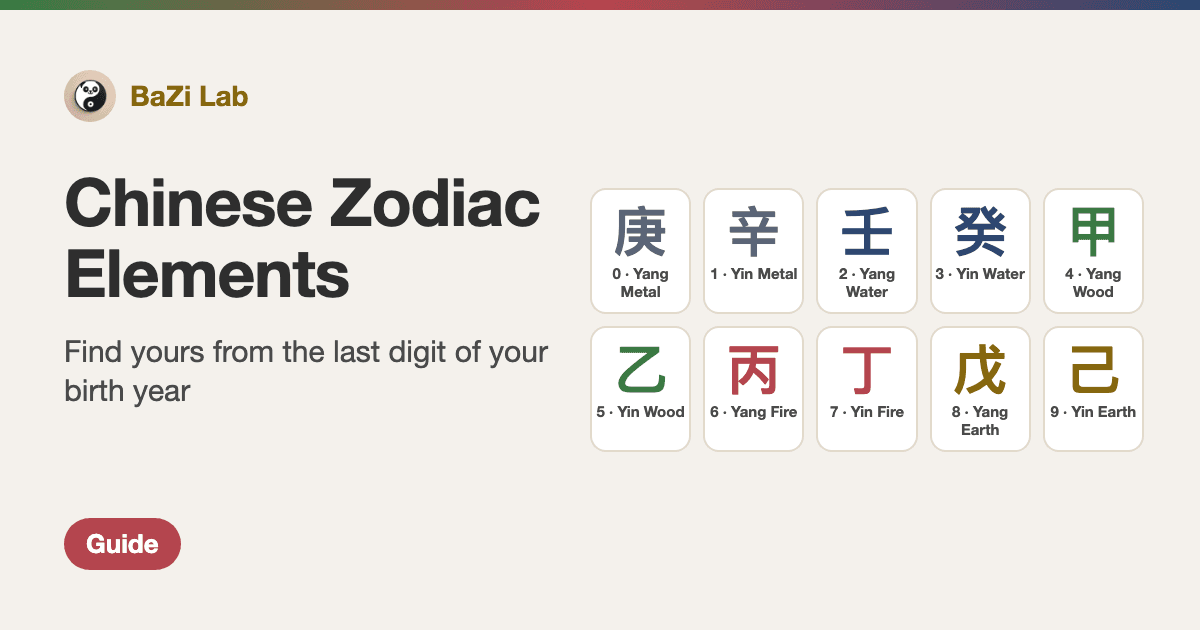
Your Chinese zodiac element is set by the heavenly stem of your birth year, not by the animal. Years ending in 4 or 5 are Wood, 6 or 7 Fire, 8 or 9 Earth, 0 or 1 Metal, and 2 or 3 Water. The ten stems and the twelve animals move at different speeds, so the same animal returns with a different element each time and the full combination only repeats every sixty years.
Why the animal is only half of the year
Every year in the Chinese calendar is written with two characters. The lower one is an earthly branch, and it gives the animal: 午 is Horse, 未 is Goat, 辰 is Dragon. The upper one is a heavenly stem, and it gives the element. It also gives the polarity — yang for 甲 丙 戊 庚 壬, yin for 乙 丁 己 辛 癸.
When an article says "the year of the Fire Horse", it is reading the stem first and the branch second. 2026 is 丙午: 丙 is yang Fire, 午 is the Horse. 2027 is 丁未: 丁 is yin Fire, 未 is the Goat. The animal is the memorable half; the element is the half that changes what the year is said to mean.
Find your element with the last digit of your birth year
The fast version needs no chart, no calculator and no birth time. Take the last digit of the year you were born:
So someone born in 1990 is 庚 Metal on the Horse: a Metal Horse. 2000 is a Metal Dragon, 2024 a Wood Dragon, 2025 a Wood Snake, 2026 a Fire Horse. The rule holds for every year from 4 CE onward, because the ten-year stem cycle divides evenly into the way the Gregorian year number counts. That covers every birth year you are likely to look up.
Two caveats. First, this gives you the year element only; a full BaZi chart has four pillars and eight characters, and the element that represents you is a different one, explained below. Second, the rule is anchored to the Chinese solar year, which starts in early February, not on 1 January, so January babies belong to the previous year's stem.
Chinese zodiac elements by year, 2024 to 2035
This is how the two cycles line up for the next twelve years, each entry calculated from the year pillar rather than copied from another list:
The pattern is not random. Wood takes two years, then Fire two, Earth two, Metal two, Water two, and the animals keep marching through their own twelve. Both cycles restart together every sixty years.
Sixty years, five of every animal
Because ten and twelve share a factor of two, only sixty of the possible combinations ever occur, and each animal appears exactly five times in one full turn. There is no such thing as "the Goat" in the abstract — there are Metal, Water, Wood, Fire and Earth Goats, and they are read differently.
For the Goat: 乙未 Wood Goat ran in 2015, 丁未 Fire Goat in 2027, 己未 Earth Goat in 1979, 辛未 Metal Goat in 1991, 癸未 Water Goat in 2003. The previous Fire Goat before 2027 was 1967, and the next one is 2087. That is why two people who both say "I'm a Goat" can be sixty years apart, or five elements apart.
The year element is not the element that describes you
This is where most zodiac articles stop, and where a BaZi reading starts. The year pillar is one of four: year, month, day and hour. It describes the environment you were born into — the family, the era, the tone of the period — not your own constitution.
The character that stands for you is the stem of the day pillar, called the day master. Two children born in the same Wood Dragon year can have a Metal day master and a Fire day master respectively, and they will be read as different people with different needs, strengths and useful elements. If someone asks "what is my element" and means themselves rather than their birth year, the day master is the honest answer.
You can find it from your birth date on the day master page, and the five elements calculator counts how much Wood, Fire, Earth, Metal and Water actually appear across all eight characters, including the hidden stems inside each branch. That count is usually more revealing than the year label: plenty of Fire Horses are short of Fire.
What the five elements are said to represent
The traditional vocabulary is consistent across Chinese astrology. Treat it as a language for describing tendencies, not a personality test with a score.
Two people can share an element and behave nothing alike, because the polarity, the branch and the rest of the chart all change the reading. This is why "Wood people are creative" style claims fall apart on inspection.
Do the elements decide zodiac compatibility?
Partly, and less than the tables suggest. Animal compatibility and element relations are two separate systems that popular articles often blend into one score.
The animal layer uses branch relationships: the six harmonies (六合), the three harmonies (三合), the clash (冲), the harm (害) and the punishment (刑). The element layer uses the generating cycle — Wood feeds Fire, Fire makes Earth, Earth bears Metal, Metal carries Water, Water grows Wood — and the controlling cycle, in which Wood breaks Earth, Earth blocks Water, Water quenches Fire, Fire melts Metal and Metal cuts Wood.
A verdict built only on animal signs ignores the day master and the rest of the chart, which is where most of the reading happens. If you want the sign-level view first, the Chinese zodiac hub lists the harmonies and clashes for all twelve animals. For a two-chart reading, the compatibility calculator compares both people's pillars instead of two animals.
The three weeks that change the answer
Chinese New Year is a lunar date and moves between 21 January and 20 February. The BaZi year always changes at Li Chun (立春, Start of Spring), which falls around 4 February. The gap between the two is where birthday lookups go wrong.
In 2023 Chinese New Year fell on 22 January, so anyone born between 22 January and 3 February was a Rabbit by the calendar but still a Tiger in a BaZi chart. 2027 shows the mirror case: Li Chun arrives on 4 February at 09:46, Chinese New Year on 6 February, so a baby born on 5 February already carries a Goat year pillar while the lunar calendar still says Horse. The 2027 BaZi year guide walks through the whole timeline, including the twelve month pillars.
There is a second trap for readers outside Asia: Li Chun is defined in Beijing time, so a birth on the evening of 3 February in New York can already fall in the new year pillar in China. The true solar time guide explains how birth time and place are corrected before the chart is cast.
Check the elements in your own chart
The year element is a good label and a poor answer to "what am I made of". If you want the real distribution, cast the chart: the BaZi calculator gives the four pillars, the day master and the hidden stems in one pass, free and without an account. The element counts that come out of it are usually more interesting than the year label.
FAQ
Is my Chinese zodiac element the same as my day master?
No. The zodiac element belongs to the year pillar and describes the environment of your birth year. The day master is the stem of your day pillar and represents you. They can be the same element, but usually are not, and the day master is the one used for personal readings.
What element is 2026?
2026 is 丙午, yang Fire over the Horse: a Fire Horse. 丙 is the sun rather than a candle, and it follows the two Wood years of 2024 and 2025.
What element is 2027?
2027 is 丁未, yin Fire over the Goat: a Fire Goat. Both 2026 and 2027 are Fire years, but 2026 is yang Fire on Fire while 2027 is yin Fire sitting on warm, dry Earth, so the second year is read as steadier and less volatile.
Why do some sites call 1974 a Wood Tiger and others a Tiger?
1974 is 甲寅, yang Wood on the Tiger, so Wood Tiger is correct. The confusion comes from mixing up the lunar year, the BaZi year and the animal-only label. If a site shows only the animal, it has thrown away the half of the year that carries the element.
Do I need my birth time to find my zodiac element?
Not for the year element, which needs only the year and the correct year boundary. You do need the hour for the fourth pillar, and for any reading that depends on the full chart — which is most of them.