BaZi Career Reading: How to Read Field, Role and Timing From Your Chart
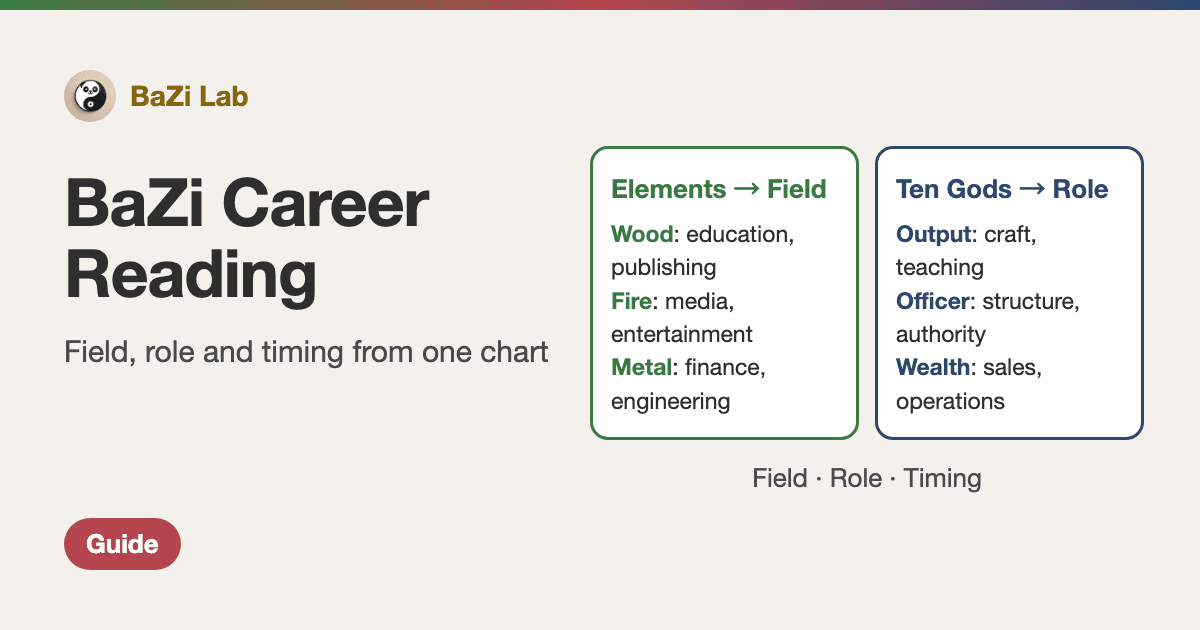
A BaZi career reading works on two axes. The element balance of your chart points to the kind of field you tend to fit, and the ten gods point to the kind of work you do well inside that field. Timing comes third, from the ten-year luck pillars. Read in that order, the chart narrows a list of options; read out of order, it turns into a horoscope that names a job title and is wrong about almost everyone.
What a career reading can and cannot do
A chart does not contain an employer, a salary or an industry. It describes how a person tends to act under pressure, what they produce easily, what drains them, and which decades carry more friction. That is useful for choosing between two offers, deciding whether to stay in a structured company or go independent, or noticing that a plan is being made in a hard decade.
It is not useful for claiming that Metal day masters should be engineers, or that a clash in the month pillar forbids self-employment. The honest framing is a filter, not a verdict. Anyone who hands you a single job title from a birth date has skipped the steps below.
Step 1: Find your day master
Everything in a BaZi reading is measured from one character: the stem of your day pillar, the day master. It represents you, and every other character in the chart is described by how it relates to it.
Take the birth date, convert it to the four pillars, and read the day stem. Born on a 辛 day, you are a yin Metal day master: precise, allergic to being rushed, better at finishing than at starting. Born on a 丙 day, you are yang Fire: visible, warm, quick to act. The day master page turns a birth date into that answer, and the BaZi calculator gives the full four pillars at once.
The day master matters for career because it tells you what kind of fuel the person runs on. A yin Metal day master and a yang Fire day master can hold the same job title and have completely different experiences of it.
Step 2: Turn the ten gods into work modes
Every other character becomes one of ten relationships to the day master, grouped into five pairs. In career terms, each pair is a mode of working rather than a profession.
The ten gods page explains how each one is derived from the day master, including the polarity rules that decide whether a relationship is "direct" or "indirect".
In a career reading, look for which two or three modes dominate, which are missing, and whether a luck pillar supplies them later. Heavy output with little officer often does better freelance; strong officer with thin output often does better inside a system.
Step 3: Separate the field from the role
This is the part most online "BaZi career" articles skip, and it is the part that makes the advice usable. Elements answer "which field"; ten gods answer "which function". A person can be a strong fit for the finance industry and a terrible fit for an accounting desk, because industry and task are different questions.
The traditional element-to-industry mapping is a starting filter, not a rule:
Then overlay the ten gods. Output inside a Water field reads as content and communications; wealth inside Metal reads as sales or deal-making in finance; officer inside Earth reads as project or site management. Because one element can serve several functions, "your element is Fire, so be a chef" is a cartoon of the method.
Step 4: Test strength before potential
Before any of this is worth much, a practitioner checks whether the day master is supported or exposed. A day master is usually called strong when the season, the branches and the supporting stems give it enough help, and weak when it is surrounded by elements that drain or control it.
The practical difference is direction:
Two competent practitioners can honestly disagree here, because weighting hidden stems and season is a judgement, not arithmetic. The five elements calculator shows the raw distribution across all eight characters.
Step 5: Add timing with the luck pillars
A chart describes a person; the luck pillars describe the decades. Each luck pillar lasts ten years and changes at a fixed age calculated from the birth date, and each one brings a new stem and branch into the chart.
For career decisions this is the most practical layer. A decade that supplies the element the chart lacks is often when someone finally gets traction in a field that felt closed. A decade that doubles down on an already-abundant element tends to produce the "everything moves, nothing lands" feeling. The luck pillars calculator plots the ten-year cycles and a year-by-year score from age 1 to 96, free and without an account.
Treat timing as a factor in when to push and when to consolidate — not as a reason to refuse an offer. The chart cannot see the offer.
A worked example
Take a man born on 15 June 1990 at 10:30 in Beijing. The four pillars are 庚午 for the year, 壬午 for the month, 辛亥 for the day and 癸巳 for the hour.
Read as a career profile, the chart is officer-heavy and output-heavy at once: structure and pressure on one side, craft on the other, with wealth present but buried. A practitioner would then ask whether the yin Metal day master is supported in a Fire month with two Water stems draining it — usually read as needing support — and would look to luck pillars for Metal and Earth.
The usable conclusion is not a job title. It is a shape: someone who does well in a structured organisation that has a real craft or communication component, who is better at making something excellent than at selling it, and for whom income tends to arrive through skill rather than through deal flow. That is a filter you can apply to a shortlist of offers.
Four mistakes that make career readings useless
1. Reading the animal instead of the chart. Your zodiac sign is the year branch. Career readings run from the day master and the ten gods, which is where the actual differentiation lives.
2. Using the year element as "your element". A Wood Dragon year does not make someone a Wood person; it describes the environment. The zodiac elements guide covers the difference in detail.
3. Skipping strength. Advice that ignores whether the day master is supported is advice about a chart that does not exist.
4. Treating the reading as a decision. The chart describes tendencies and timing. The manager, the pay, the commute and the company's health are not in it.
FAQ
Can BaZi tell me which career to choose?
It can narrow the field and the function, and it can flag decades with more friction, but it cannot see a specific employer or salary. Use it to filter options and to time decisions, not to pick a job title.
What is a "career pillar" in BaZi?
People usually mean the month pillar, which describes the working environment and the relationship with authority, or the current luck pillar, which describes the decade. Both are read relative to the day master.
Is a strong day master better for a career?
Neither is better. A supported day master can carry more output and responsibility; an exposed one does better with foundations, allies and structure first. The advice differs, the value does not.
How accurate is a BaZi career reading?
It is a model, not a measurement. Its value is in describing patterns and timing consistently, and in forcing you to separate field, function and moment.
Where to go next
If you want the full picture rather than a single axis, the overview report reads career, money and relationships from one chart, and BaZi Agent will answer a specific question — an offer, a move, a partnership — after calculating the chart itself.